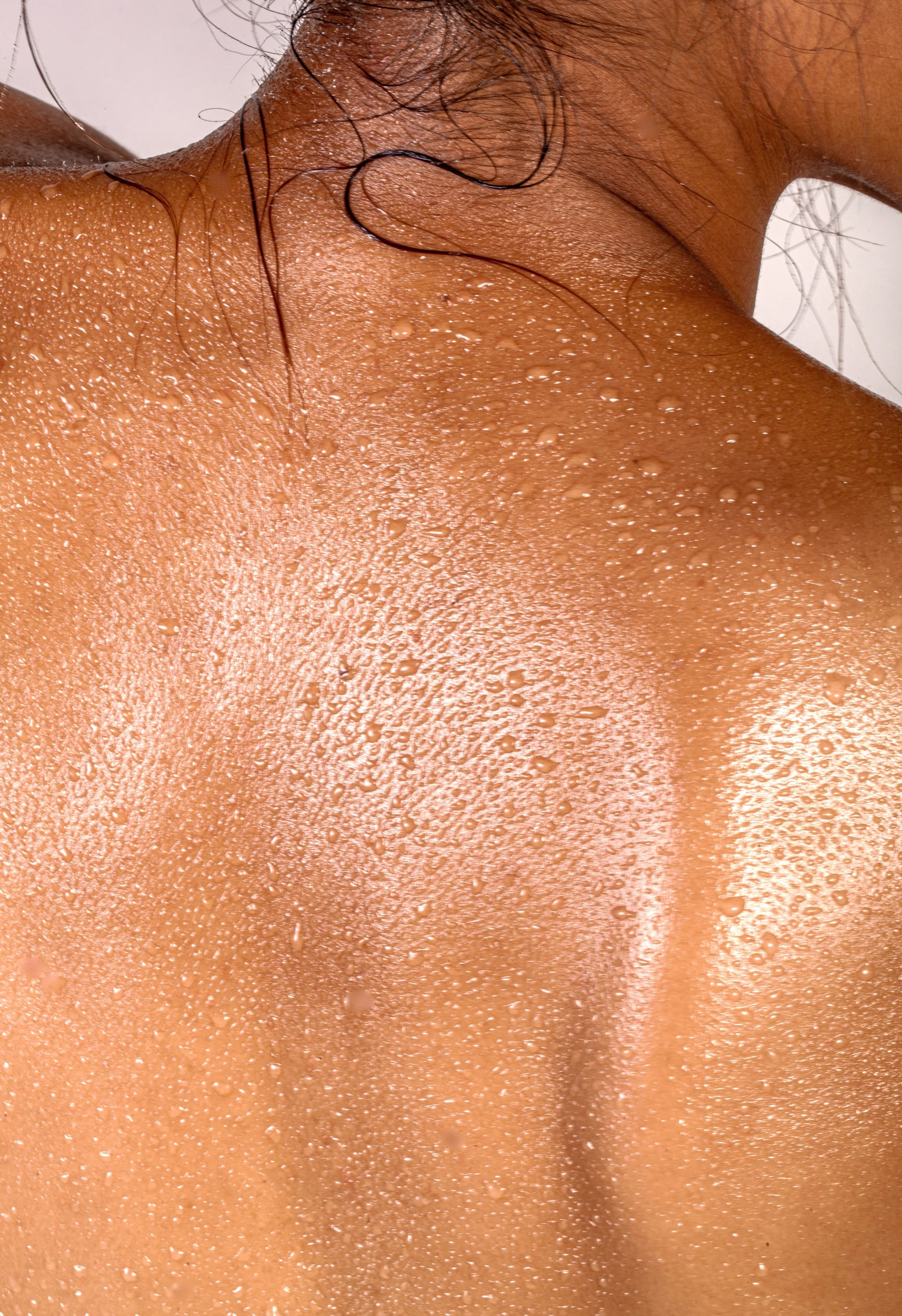
"Drink more water for glowing skin" gets repeated so often it sounds like settled science, but your skin's outer layer (the thin barrier that keeps moisture in and irritants out) runs on a far more specific water balance than a full glass tells you. Research shows hydration controls exactly how your skin sheds dead cells, protects itself, and stays flexible. By the end of this blog post, you'll know what skin hydration actually does, how your skin manages it on its own, and where its power runs out.
Why Dry Skin Flakes Instead of Shedding Smoothly
Your skin sheds dead cells all the time, you just never see it happen. That quiet shedding depends on water. Tiny enzymes in the skin's outer layer only work properly when there's enough moisture around them, and their job is to dissolve the "glue" holding old, dead cells to the surface so they release one by one. When your skin dries out, those enzymes slow down, the glue doesn't fully dissolve, and dead cells pile up instead of falling away cleanly. That buildup is what actually causes the flaking, dullness, and rough patches people associate with dry skin. It's not that dry skin is "missing" something decorative, it's that a working process has stalled (Rawlings & Harding, 2004).
Why Water Alone Can't Keep Skin Hydrated
Water doesn't just sit in your skin on its own, it has to be sealed in. Your skin makes its own "seal" out of three fats (ceramides, cholesterol, and fatty acids) that fit together like mortar between bricks, blocking water from escaping and keeping irritants out (Feingold & Elias, 2014). When that seal breaks down, water evaporates faster and your skin grows more vulnerable to dry air and harsh products. Fixing it isn't as simple as slathering on any fat, either. Studies on skin repair show these three fats need to be in roughly their natural balance, or healing is measurably slower than doing nothing (Man et al., 1996). A moisturizer with the wrong mix patches a symptom instead of rebuilding the seal.
Why Drinking Extra Water Doesn't "Plump" Normal Skin
Your skin does have a built-in channel that pulls water up from deeper layers into the outer skin, so what you drink isn't completely irrelevant (Hara-Chikuma & Verkman, 2008). If you're genuinely dehydrated, that channel matters. This channel is tightly controlled by your body, and not by a tap you can open wider by drinking more. If you're already getting enough fluids, then the control mechanism stops the extra water from making its way into your skin as visible hydration. Your body simply doesn't have a way to "bank" the surplus. That's the main reason researchers have found no real evidence behind the popular "eight glasses a day for your skin" advice (Wolf et al., 2010).
Wrap Up
Skin hydration is a carefully controlled system run by enzymes and fats, not a tank you top off by drinking more water. Its real power is smooth shedding and a strong skin barrier, and it is limited by already being hydrated... so drinking more barely moves the needle for your skin.
If you don't know your skin type, take the quiz, or checkout our list of recommended products.
References
Feingold, K. R., & Elias, P. M. (2014). Role of lipids in the formation and maintenance of the cutaneous permeability barrier. Biochimica et Biophysica Acta (BBA) – Molecular and Cell Biology of Lipids, 1841(3), 280–294. https://doi.org/10.1016/j.bbalip.2013.11.007
Hara-Chikuma, M., & Verkman, A. S. (2008). Roles of aquaporin-3 in the epidermis. Journal of Investigative Dermatology, 128(9), 2145–2151. https://doi.org/10.1038/jid.2008.70
Man, M. Q., Feingold, K. R., Thornfeldt, C. R., & Elias, P. M. (1996). Optimization of physiological lipid mixtures for barrier repair. Journal of Investigative Dermatology, 106(5), 1096–1101. https://doi.org/10.1111/1523-1747.ep12340135
Rawlings, A. V., & Harding, C. R. (2004). Moisturization and skin barrier function. Dermatologic Therapy, 17(s1), 43–48. https://doi.org/10.1111/j.1396-0296.2004.04S1005.x
Wolf, R., Wolf, D., Rudikoff, D., & Parish, L. C. (2010). Nutrition and water: Drinking eight glasses of water a day ensures proper skin hydration—myth or reality? Clinics in Dermatology, 28(4), 380–383. https://doi.org/10.1016/j.clindermatol.2010.03.022